Whole Foods Innerview App
UX research uncovered why Whole Foods' Innerview App struggled with adoption
When Whole Foods Market launched Innerview, a new operations app for their employees, adoption stayed low. Rather than jump to redesign, Openfield applied our expertise in the EdTech space to understand what actually drives workplace learning, and found a much bigger opportunity.
From Low Adoption to Strategic Foundation

Innerview had low adoption, but the cause was unknown. Whole Foods needed to understand what was actually getting in the way before investing in any solution.

Conducted a three-phase research engagement—foundational discovery, targeted deep dives into benefits and product search, and design validation—to understand employees holistically: their real workflows, cultural anxieties, analog preferences, and authentic learning needs.

Guiding principles applicable across all future Whole Foods Market initiatives, validated personas, improved wireframes for two key product areas, and a strategic roadmap grounded in evidence rather than assumption.

A Three-Phase Research Engagement Built on Evidence, Not Assumptions
Phase 1: How Foundational Discovery Removes Research Bias
We started broad, building a baseline understanding of their employees’ daily experiences, pain points, and what they valued most in their work. Good design doesn't exist in a vacuum. Understanding the environment a product is used in reduces bias and builds stronger, more durable knowledge.
Phase 2: How Targeted Deep Dives Build on What You Already Know
With the foundation in place, we focused on two areas where they struggled most: benefits discovery and product search. They often didn't know resources like mental health counseling were available until a crisis hit. And when customers asked floor staff about products, the app wasn't fast enough to help in the moment that mattered. Each deep dive built on foundational insights rather than starting from scratch.
Phase 3: How Design Validation Connects Solutions to Real Problems
We created and tested wireframes for the Innerview experience, measuring prototypes against both the existing experience and the guiding principles we'd established. This ensured solutions addressed actual problems, not assumed ones.
Guiding Principles That Apply Across Every Future Initiative
When companies skip foundational research, they risk prioritizing the wrong things or designing solutions that undermine the experience later. The guiding principles we established can now be applied across any future Whole Foods Market initiative. Any new design idea can be measured against this framework before a single line of code is written.
The research gave us a foundation we could build on, not just for this app, but for understanding how to support Team Members across everything we do.
Andrew, Whole Foods Market Product Leader
Why Cultural Resistance Was the Real Barrier to App Adoption
Amazon’s Acquisition Created Potential for Cultural Resistance to New Technology
Following the Amazon acquisition, employees were concerned that Amazon's efficiency mindset would erode the creativity and entrepreneurialism that defined Whole Foods Market culture. Many were resistant to new technology, especially tools that felt imposed rather than helpful. Understanding this fear was essential context that no app audit would have revealed.
Clipboards and Checklists Were Winning — and We Needed to Know Why
Many relied on clipboards, checklists, and physical discount cards. Some couldn't even use phones on the floor. Rather than dismiss these habits, we needed to understand why the analog processes worked. Any digital experience would have to earn its place in a well-established routine.
Making Digital More Valuable Than Analog
People don't disrupt their lives to use technology. Technology only earns adoption when it fits seamlessly into someone's existing life. Our goal was to understand what they already valued so we could identify where a digital experience could genuinely outperform what they were already doing with a clipboard.
Learning Often Happens on the Job
Effective workplace learning doesn't happen in scheduled sessions. It happens when employees can access the right information at exactly the moment they need it—whether they're answering a customer's question on the floor or navigating a major life transition and wondering what benefits they have.
In-Context Research Revealed What Lab Studies Never Could
Reaching People Where They Work
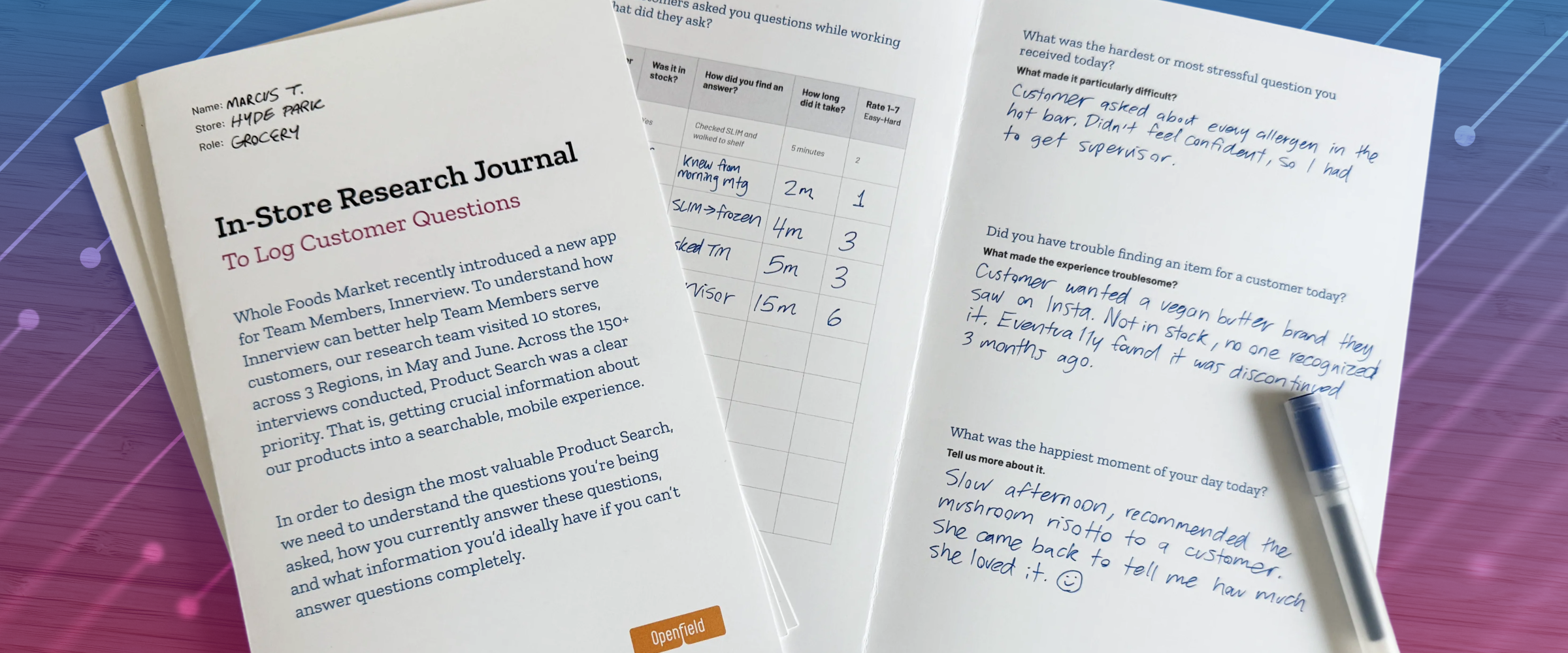
We traveled to stores across America to observe employees during actual shifts. Not all had email, so we worked with managers to create access. We also left journals with pointed questions that they could complete throughout their week. This method mirrored the analog tools we saw everywhere and captured insights that would have otherwise slipped through.
As a third-party partner, we had an advantage internal teams often lack: neutrality. Once they understood we were an outside partner with no stake in their review, they opened up in ways that made the research genuinely honest.
The Multi-Method Approach That Produced Authentic, Actionable Insights
Avoid Bias Through Multi-Method Research
We combined ethnographic observation, in-person interviews, cultural probes, and remote focus groups. This multi-method approach let users show us their reality instead of just describing it. Each round of research built on the last, so new findings enhanced existing knowledge rather than duplicating it.
Regional Store Visits Produced More Authentic Data Than Any Lab Setting
We traveled to stores across regions and combined synchronous and asynchronous participation methods so employees could contribute on their own schedule. This flexibility mirrors how we accommodate diverse learner needs, and it produced more authentic data than any lab setting could.
Leverage Neutrality to Build Trust
As a third-party partner, Openfield had something internal teams often can't offer: the perception of safety. They shared honestly because they knew we weren't there to evaluate them. Trust made the data real.
Understanding an Established Ecosystem of Behaviors was the Foundation for Strategic Improvements
Innerview didn't fail in isolation. It failed to integrate into an ecosystem of established behaviors and a fiercely protected culture. We mapped complete shift journeys, identifying when and why employees chose certain tools and where friction accumulated. Our EdTech background taught us that adoption isn't about building better features—it's about connecting tools across complex ecosystems where multiple systems and processes need to work together seamlessly.

About Whole Foods
Founded in 1980 in Austin, Texas, Whole Foods Market is the leading natural and organic grocery retailer in the United States, operating more than 500 stores across North America and the United Kingdom. With a team of over 100,000 Team Members, the company is known for its commitment to quality standards, responsible sourcing, and creating a shopping experience rooted in transparency and trust. In 2017, Whole Foods became a subsidiary of Amazon, accelerating its investment in technology and operational tools designed to better support both customers and the people serving them every day.
More About...
Transform User Problems into User Delight
Most EdTech teams know something isn't working — but knowing what to fix, how to fix it, and in what order requires specialized expertise.
Pinpoint Real User Problems
Our Research & Testing services can help you pinpoint what's actually broken and why.
Learn MoreMake Confident Product Decisions
Our Ideation & Planning services help you prioritize roadmap updates with business justification.
Learn MoreDesign and Validate Before You Build
Our Design & Prototyping services help you reduce engineering risks and costly reworks.
Learn MoreSchedule an Introductory Meeting
Let's discuss how we can bring a new level of speed and confidence to help you address critical UX problems that threaten your product’s future success.
"*" indicates required fields