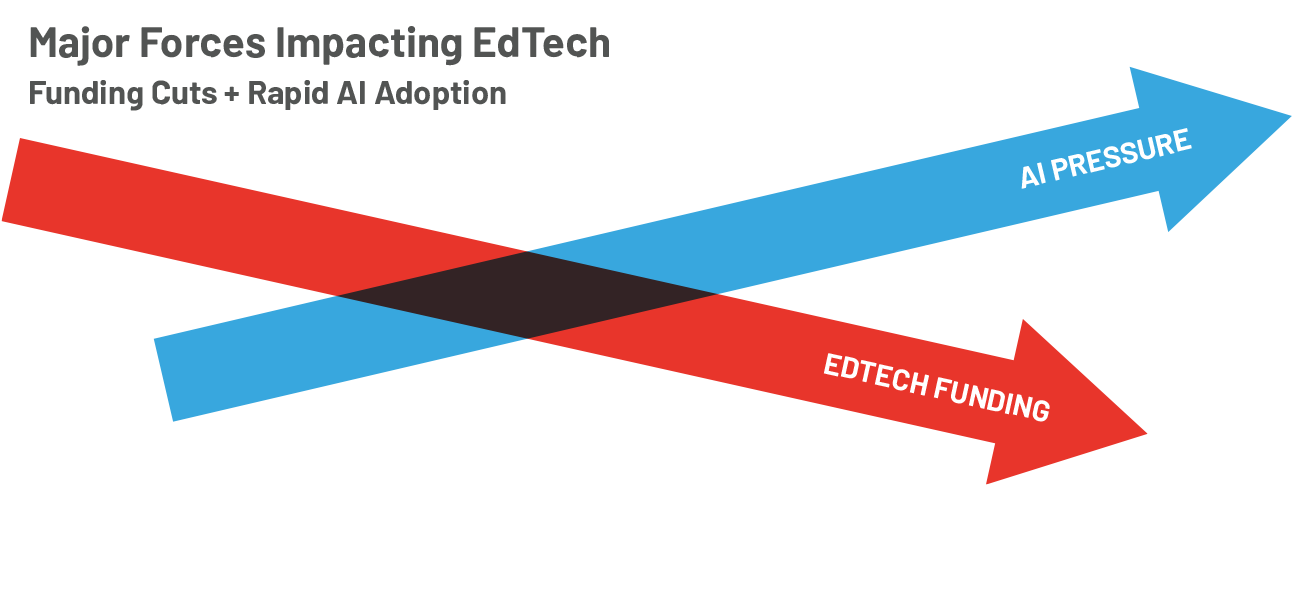
2025 marked a decisive shift in EdTech product development, where market pressures from reduced education funding across both K-12 and higher education and rapid AI adoption exacerbated what we call the “confidence gap,” the growing challenge of getting product decisions right in an increasingly uncertain environment.
The new norm is an imperative to get more done with less, and faster. But speed and confidence don’t have to be opposing forces. EdTech product teams that require more from their UX teams and partners to help them prove they’re focused on the right problems with the right solutions will have an opportunity to pull ahead of those who don’t.
In This Article:
- What Were the Biggest Challenges Facing EdTech in 2025?
- What is the Confidence Gap in EdTech Product Development?
- How Research and Design Must Do More to Help Increase Certainty
- How Can You Start Closing the Confidence Gap Today?
- How Should EdTech Product Leaders Ensure UX Supports Product Efficacy and Growth in 2026?
- TL;DR: Key Takeaways from 2025
What Were the Biggest Challenges Facing EdTech in 2025?
We’re currently conducting a survey of what product leaders like you expect from 2026. Without getting ahead of our upcoming 2026 EdTech UX Outlook, available in January, it’s clear two massive forces collided in 2025:
- Dramatic funding cuts across all education sectors
- The rapid maturation of AI that fundamentally changed what users expect from educational software as well as how EdTech teams work
Together these challenges created a pressure-cooker environment where mistakes became more costly and time to make confident decisions kept shrinking. Nearly everyone who has responded to the survey so far has noted one or both of these issues among their top concerns heading into 2026.
There’s still time to make your voice heard. Take the survey here.
The Funding Reality
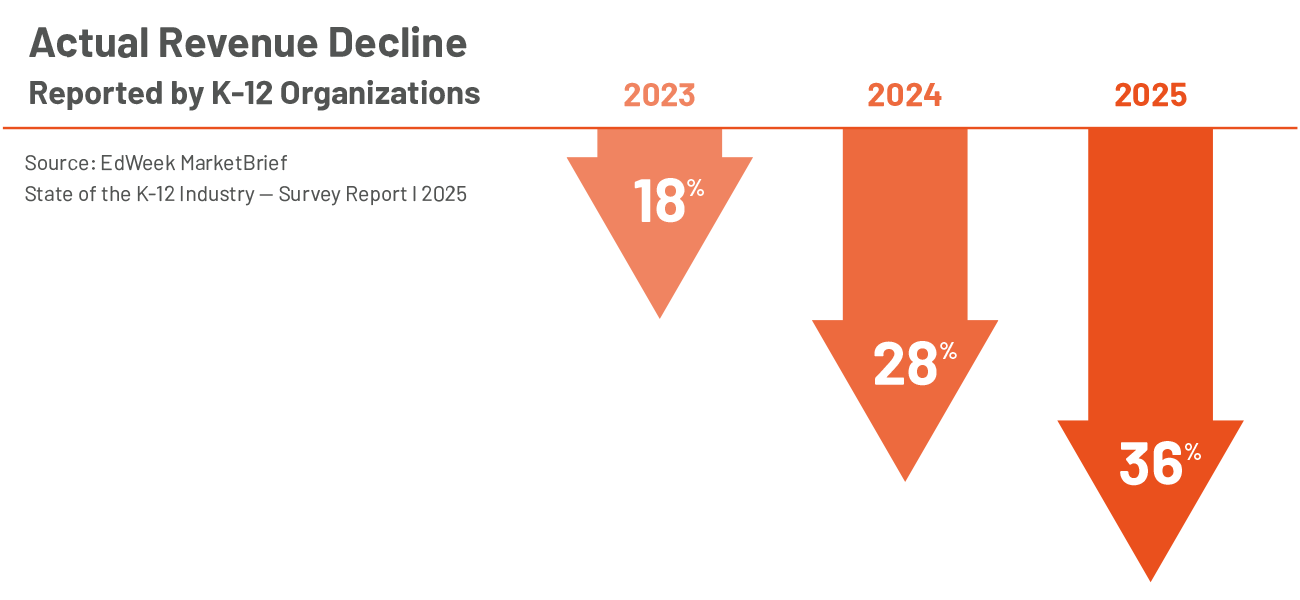
The financial pressures weren’t subtle. According to EdWeek Market Brief’s 2025 State of the K-12 Industry report, actual revenues fell for 36% of K-12 organizations over the past year, compared to 28% in 2024 and just 18% in 2023. The post-ESSER funding undoubtedly contributed heavily to these reductions, hitting harder for those who failed to adequately prepare for it.
Higher education faced its own issues. Undergraduate enrollment dropped 5.6% in fall 2023, with community colleges experiencing a 12% decline. Between spring 2019 and spring 2023, higher education lost 1.4 million students. Multi-year state funding cuts for public institutions added to the strain.
For EdTech companies, these institutional pressures created immediate impacts. EdTech venture funding in Q1 2025 dropped 50% to $150 million, down from $300 million in Q1 2024 — far from the $8.3 billion peak in 2021.
Buyers became far more selective, demanding proof of efficacy and immediate instructional value before signing shorter-term contracts. As one higher education technology leader noted in the Educause 2026 Top 10 priorities, institutions are “turning to data as a guide to help them navigate complicated decisions” and making “better technology investment decisions through clear cost, ROI and legacy systems assessments.”
The AI Expectation Gap
While funding challenges squeezed from one side, AI disruption pushed from the other. 2025 wasn’t the year AI arrived, it was the year expectations got serious.
Today’s students and educators use sophisticated AI tools daily. They bring these expectations to educational contexts, creating a remarkably high bar for AI features in EdTech products. Users have little patience for AI implementations that feel limited or disconnected from their workflows.
The technical landscape evolved dramatically. AI capabilities once available only to specialized teams became accessible to nearly everyone. This democratization intensified competition while raising the bar for valuable AI implementation. Companies could no longer win simply by adding “AI-powered” to feature lists.
There’s a growing chorus of voices becoming more critical about AI implementation in EdTech products. If 2025 was the year AI moved from experimentation to implementation, 2026 will be the year winning products figure out how AI truly moves the needle in delivering proof of efficacy.
— Trevor Minton, Chief Experience Officer, Openfield
The shift from experimental to pragmatic AI created a critical insight: 2026 will be the year that winning EdTech products figure out how to prove advancements in efficacy by delivering AI value that goes beyond what users can access elsewhere. Whether you have an internal UX team, work with an external partner, or a blend of the two, the first rule of EdTech UX is do no harm to the product’s ability to deliver efficacy.
What is the Confidence Gap in EdTech Product Development?
Throughout 2025, we kept hearing variations of the same concern from product leaders: “How do I know I’m making the right call?” With budgets tighter, stakes higher, and market dynamics shifting rapidly, the distance between what product leaders need to know and what they actually know with certainty keeps growing. That’s the “confidence gap” — the defining challenge facing EdTech product development today.
The Right Strategic UX Partner Will Help You Navigate Critical Decisions That Demand Higher Confidence
When it comes to moving the needle on product efficacy and enabling growth, not all product decisions carry equal weight. A strategic UX partner focused solely on the complexities of EdTech can serve as a guide because they’ve seen the patterns over and over again. The right blend of qualitative and quantitative UX research, and smarter design and prototyping methods built upon decades of experience solving educational challenges can help you navigate these six high-stakes choices that hurt most when confidence is lacking:
- Pinpointing user problems worth solving. Just because users complain about something doesn’t mean they’ll pay to fix it. Is the pain real enough to drive meaningful action? User research helps identify which problems cause the most pain and whether current workarounds are “good enough” or painful enough to warrant investment.
- Designing solutions that actually work at scale. A solution that works for your most sophisticated users might confuse the majority. Strategic UX design ensures your approach works across the full diversity of your user base, not just your power users.
- Building features that engineering can actually deliver. The most expensive outcome is discovering after launch that your beautifully designed solution doesn’t work technically or requires costly rework. Effective collaboration between design and engineering validates technical feasibility early and creates smoother handoffs that reduce build time and rework.
- Prioritizing improvements with the most market impact. With limited engineering resources, choosing what to build next becomes a zero-sum game. How do you know Feature A will drive more value than Feature B? The right blend of qualitative and quantitative research is required.
- Differentiating in increasingly competitive markets. Features that were differentiators 18 months ago may now be table stakes. What will actually set you apart and justify your pricing?
- Building internal stakeholder consensus. When different leaders interpret user feedback differently, how do you align everyone around shared understanding of priorities?
Why the Confidence Gap Grew Wider in 2025
Several forces converged to widen the confidence gap:
- Market uncertainty made assumptions riskier. When enrollment trends shift, funding sources disappear, and buyer priorities evolve rapidly, yesterday’s assumptions become today’s liabilities.
- Shrinking budgets meant less room for error. As the institutions that EdTech companies sell to faced declining revenues and reduced staff, budgets for improvements were restricted for many product teams. Every product decision had to count. Reworks or do-overs were not an option.
- Small teams wore too many hats. Product teams found themselves responsible for strategy, research, design, and project management simultaneously, leaving little capacity for the deep validation work that builds confidence.
- Pressure to move quickly while proving value created impossible tradeoffs. AI-accelerated development cycles meant competitors could ship features faster. But rushed decisions without proper validation led to costly reworks and features that missed the mark. We saw this firsthand as we redesigned and created new prototypes for clients who had been tricked into thinking slick AI-generated demos that were not properly vetted failed miserably with users.
How Research and Design Must Do More to Help Increase Certainty
Many EdTech companies don’t have the luxury of comprehensive research programs or large design teams. But you can’t afford to allow a lackluster user experience to threaten the efficacy of your product, which in turn threatens sales. Strategic research and design at critical decision points provides disproportionate value. The key is validating decisions where uncertainty carries the highest cost.
Pinpoint User Problems Worth Solving
Before you invest in design and development, user research confirms which problems warrant solutions. This isn’t about gathering opinions — it’s about understanding which problems cause the most pain, how often users encounter them, and whether current workarounds are “good enough” to maintain the status quo.
- Research prevents costly development mistakes before they happen. When you validate problem-solution fit before committing engineering resources, you avoid the most expensive outcome: building something users don’t want or won’t use.
- Research provides statistical confidence over stakeholder opinions. Quantitative validation at scale provides data to move beyond opinion and build stakeholder consensus around shared understanding of user priorities.
- Research uncovers unarticulated needs. Users can tell you what frustrates them, but they’re not always good at imagining solutions. Strategic UX research teases out underlying needs that users can’t articulate, helping you innovate in ways that feel obvious in hindsight but require skill to discover.
With more than 40,000 hours of EdTech user research across K-12, higher education, and corporate learning, we’ve seen how early validation prevents the most expensive mistakes.
Design the Right Solutions, and Prove Them
Once you understand which problems to solve, strategic UX design ensures your solutions actually work at scale. This is where concepts become tangible, interactions get refined, and you test whether your approach resonates across your full user base.
Rapid prototyping enables fast iteration with real user feedback. Testing interaction patterns and workflows before full development lets you refine approaches, catch fatal flaws, and build confidence that your engineering investment will pay off. Small usability issues can tank adoption of otherwise sound solutions. The right prototyping catches these early.
Design testing validates solutions across diverse user segments. What works for community college instructors might not work for K-12 teachers. What works for administrators might not work for end users. Testing designs across segments reveals where solutions need flexibility or customization.
Reduce Engineering Pain Through Better Collaboration
Even brilliant research insights and thoughtful designs fail if they can’t be built efficiently or aren’t technically feasible. Effective collaboration between UX and engineering teams transforms the product development process from a series of painful handoffs into a smooth workflow that increases speed and reduces costly rework.
Early technical validation prevents expensive rework. When designers and engineers collaborate early, you catch technical constraints and feasibility issues before detailed design work is complete. This prevents the common pattern of designing something beautiful that can’t be built within technical or budget constraints.
Better handoff materials accelerate builds and reduce mistakes. Clear documentation, interactive prototypes, and design systems reduce the back-and-forth questions that slow engineering teams. When engineers have exactly what they need to build correctly the first time, development moves faster.
Continuous collaboration catches usability issues before launch. When UX teams work alongside engineering throughout implementation, they catch issues as they emerge rather than discovering problems only after launch. This prevents the costly cycle of building, launching, discovering issues, and rebuilding.
The research-design-engineering triad creates a powerful flywheel: research identifies the right problems, design creates solutions that work for users, and tight engineering collaboration ensures those solutions ship quickly without rework.
What Does Confidence Look Like in Practice?
When product teams validate decisions through strategic research, design the right solutions, and collaborate effectively with engineering, the results are measurable. Here’s what closing the confidence gap delivered for EdTech companies we’ve worked with:
Pinpointing the Right Problems Saves Time and Resources
When we diagnosed user pain points in WileyPLUS’s student registration flow before redesigning, we identified quick wins that reduced the burden on Wiley’s customer experience team by 80%. The redesigned flow achieved an 81% free trial conversion rate — a 68% increase from the previous design. Starting with the right problem diagnosis made all the difference.
Designing Solutions That Work at Scale Reduces Support Burden
After redesigning Gallopade’s initial setup experience based on user research, teachers cleared setup hurdles faster and moved on to using advanced features. Despite serving 16% more users, total help searches dropped 33% — resulting in a 42% reduction in per-capita search volume. When design solutions address the real friction points, users succeed without needing constant support.
Strategic Collaboration Accelerates Engineering Confidence
Our staged rapid prototyping approach for iClicker’s AI Question Generator let engineering move quickly with confidence. By validating concepts and interactions before full development, we accelerated the AI feature launch while ensuring quality. Smart UX strategy doesn’t slow teams down — it helps them move faster by reducing uncertainty.
Research-Informed Systems Eliminate Wasted Engineering Time
A new design system for Macmillan Learning eliminated wasted engineering time and unified user experiences across their product suite. When design decisions are validated once and codified in reusable systems, engineering teams stop reinventing solutions and focus on building new value.
How Can You Start Closing the Confidence Gap Today?
Closing the confidence gap doesn’t require unlimited budgets — it requires strategic validation at key decision points. To help product teams move quickly with minimal cost impact, we’ve designed focused packages specifically that help validate critical decisions:
Problem-Solution Fit Validation — When you need to choose among multiple opportunities or prove which problems warrant solutions, quantitative validation provides data at scale in four weeks. Starting at $8,000 for Problem Validation or $12,000 for Solution Validation. Learn more.
Pricing Strategy Research — Understand what the market will support, willingness to pay across segments, and packaging strategies that maximize both adoption and revenue inside of four weeks. Fee: $10,000. Learn more.
3-Day Ideation Workshop — Rapidly generate and evaluate solution concepts with structure and EdTech expertise. Move from ambiguous challenges to concrete concepts in three days. Workshop fee: $8,000. Learn more.
Rapid Prototyping Series — Test interaction patterns with real users before committing to full development. Iterate quickly on complex features where small usability details make the difference. Fee starts at $7,000. Learn more.
Acute Diagnostic & Action Plan — Get focused assessment of your product’s highest-priority pain points and competitive positioning, resulting in clear “solve this first” guidance. Fee starts at $12,500. Learn more.
These packages are designed as low-barrier entry points that help you experience the value of strategic validation without long-term commitments.
Want to Explore Which Approach Fits Your Challenges?
Schedule a 30-minute discovery call to learn how we can help you be more confident about critical product decisions in 2026.
How Should EdTech Product Leaders Ensure UX Supports Product Efficacy and Growth in 2026?
Genuine opportunities exist for product leaders who approach decisions strategically in the face of EdTech disruption. But focusing on the right user problems, designing solutions that truly meet market demand, and ensuring smooth builds that are free of costly reworks will be more critical in 2026. The pressure to prove efficacy will be greater than ever as K-12 and higher ed institutions continue to grapple with less funding and decreasing revenue. Your UX team’s ability to rise to the challenge might be the difference between success and failure.
Building Confidence Into Your Process
The patterns separating successful teams from struggling ones weren’t about having bigger budgets — they were about how decisions got made:
Start with validation, not assumptions. Even small validation investments before major development commitments pay for themselves many times over by catching misalignment early.
Test designs with small investments before large commitments. A $12,000 solution validation that prevents a $300,000 engineering investment in the wrong direction delivers spectacular returns.
Collaborate between design and engineering early. Early technical validation and better handoffs prevent the painful rework cycle that happens when designs can’t be built as conceived.
Seek EdTech-specific expertise. Educational technology operates under complicated constraints that generic approaches don’t account for: multiple stakeholder groups, institutional adoption patterns, compliance requirements, and pedagogical considerations. Working with a generalist agency means you’re paying as they learn. But working with a UX team that is solely focused on EdTech means you only have to run 13.1 miles of a full marathon.
Use data to build stakeholder consensus. Quantitative validation provides shared ground for alignment. Proving to your stakeholders that you’re focused on the right problems that represent the best opportunities at scale eliminates opinion-based decision making that can result in reworks that waste budget and create setbacks that allow competitors to get ahead.
Companies that will thrive in 2026 aren’t those with the biggest budgets — they’re the ones that apply strategic validation at the moments that matter most. Stay tuned for our upcoming 2026 EdTech UX Outlook in January for a deeper dive on that.
TL;DR: Key Takeaways from 2025
- Dual pressures defined 2025: EdTech faced unprecedented challenges from simultaneous funding cuts and AI disruption, creating the “confidence gap” in product development decisions.
- Financial reality hardened: 36% of K-12 organizations saw revenue declines, higher education lost 1.4 million students, and EdTech venture funding dropped 50% in Q1 2025.
- AI expectations matured: Users now compare EdTech AI to pervasive platforms like ChatGPT, demanding domain-specific value through thoughtful design and integration.
- Confidence gap emerged as a central challenge: Product leaders struggle with high-stakes decisions when budgets are tight and mistakes are costly.
- Strategic UX research and design close the gap: Companies that validated decisions through research, designed solutions that work at scale, and collaborated effectively with engineering moved faster with less risk.
- 2026 requires elevated strategic confidence: Focus validation on critical decisions, balance research and design investment, optimize engineering collaboration, and use data to build stakeholder consensus.
Ready to Close Your Confidence Gap?
Want to discuss how an EdTech-focus UX research and design partner can help your team make better decisions faster in 2026?