At the end of 2025, we explored the growing “confidence gap” facing EdTech product leaders — the widening distance between what they need to know with certainty and what they actually know when making critical product decisions. Budget pressures, AI disruption, and market uncertainty have created an environment where mistakes became more costly and the time to make confident decisions kept shrinking.
As we enter 2026, that gap hasn’t closed. If anything, the forces creating it have intensified — and they’re converging around a fundamental shift in what the market demands from EdTech products like yours.
Understanding What EdTech Leaders Face This Year
To understand what EdTech product leaders are thinking about this year, we surveyed people across the industry, asking four key questions about their biggest challenges, trends they’re preparing for, what would improve their success, and what answers they most need about their products and users. We greatly appreciate the input!
Their responses, combined with our insights from 20 years of EdTech UX research and design, plus broader industry research from leading industry sources such as Holon IQ’s 2026 Global Education Outlook, 1EdTech, SETDA, EdWeek Market Brief, and eSchool News reveal numerous challenges across every dimension of EdTech product development.
- Shrinking budgets and intensifying scrutiny force products to prove they solve problems institutions can’t afford to leave unsolved
- The reality gap between vendor assumptions and school contexts reveals that sophisticated features mean nothing if schools can’t implement them successfully
- AI implementation pressures demand transparency, accountability, and proof that AI enhances learning rather than just matching competitor offerings
- Policy and funding uncertainty makes adaptability and evidence of fundamental value more critical than ever
The common thread? Market uncertainty continues in 2026 as EdTech product leaders grasp for better frameworks to help them make more confident decisions.
Welcome to the Efficacy Reckoning.
The EdTech market is experiencing a wake-up moment driven by a fundamental shift in how institutional buyers are held accountable for their purchasing decisions.
For the past 3-5 years, district administrators, curriculum directors, and institutional decision-makers operated with relatively more latitude in approving EdTech programs and software. Budget environments were more forgiving. The consequences of backing an ineffective tool were less severe. Buyers could approve products based on potential impact, innovative features, or vendor relationships without facing intensive scrutiny over measurable outcomes.
That era has ended.
Policy changes, dramatically reduced funding, and increased oversight mean institutional buyers now face direct accountability for every purchasing decision. They must justify each software investment to school boards, state agencies, and increasingly skeptical stakeholders who demand proof of ROI. The question is no longer “Does this product seem promising?” but “Can you prove this product delivers the outcomes we’re accountable for?”
This accountability cascade is reshaping what buyers demand from EdTech vendors: proof. Not promises of impact — evidence of impact. Not assumptions about learning outcomes — data demonstrating measurable results. Not engagement for its own sake — engagement that translates into the accountability metrics institutions must deliver.
This isn’t just another market trend. It’s a reckoning that separates evidence-backed products from those built on assumptions. Products that can demonstrate measurable impact will thrive. Those that can’t — even sophisticated, well-engineered products — will struggle to survive budget scrutiny, compete for shrinking resources, and justify their place in increasingly skeptical institutions. Winning in 2026 will require lockstep collaboration among your product leadership, learning science, UX and engineering teams.
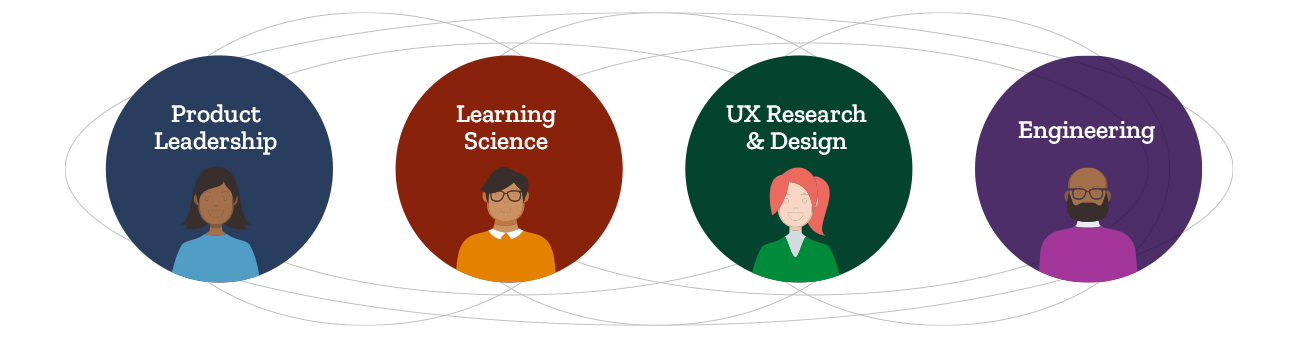
Specifically, the relationship between your learning science and UX teams is critical in this new landscape of accountability. While there is overlap between the two, your learning science team must provide the pedagogical foundation and validation of true educational impact while your UX team must help you ensure you’re focused on the right set of user problems and develop validated solutions that help you stake a unique position in the marketplace.
Why This Matters Now
The efficacy reckoning creates extraordinary pressure for product leaders. It’s no longer enough to build innovative features, move fast, or match competitors. Every product decision now carries the weight of fundamental questions your learning science and UX teams must help you answer:
- Can we prove educational impact? (learning science team)
- Are we focusing on the right problems at scale with differentiated solutions that actually work? (UX team)

Here’s a Truth We’ve Learned From 20 Years Working Exclusively in EdTech
Great UX research and design alone won’t guarantee your product’s success. But even when you do everything else right — when your learning science is sound, your engineering is solid, your go-to-market is strong, your pricing is competitive — a lackluster or frustrating user experience that isn’t laser focused on the right problems will unravel everything.
In a recent guest article on EdTech Digest, Alex Galvagni, CEO of Age of Learning, had this to say about the importance of design: “Here’s an uncomfortable truth about EdTech in classrooms: most of it doesn’t work. Not because the industry lacks talent or research. There are brilliant educators, solid pedagogical frameworks, and genuine effort behind these programs. They fail because they’re designed to please procurement committees, not to engage kids in the way they want to learn… It’s a failure of design.”
Strategic EdTech UX isn’t about making product screens pretty. It’s about closing the confidence gap between what you need to know and what you know with greater certainty. It’s about validating that you’re solving the right problems, designing solutions that genuinely work for users in their real contexts, building the evidence institutional buyers demand, and ensuring those solutions can be built efficiently by engineering. Most of all, it’s about understanding how to create features that align with the principles of learning science.
That’s the lens through which we’ve analyzed the trends and challenges ahead, and the framework for navigating 2026’s efficacy reckoning with confidence rather than anxiety.
In This Outlook
- What We Heard from EdTech Product Leaders
- What Other EdTech Trends Should Product Leaders Watch in 2026?
- Accessibility Compliance is Creating a Red Alert for EdTech in 2026
- Workforce Learning: The Rise of Upskilling and Reskilling
- Career and Technical Education Gets a Technology Upgrade
- Interoperability and Business Model Evolution: When Integration Becomes Non-Negotiable
- How Are Skills-Based Credentials Changing Education?
- Conclusion: From Uncertainty to Strategic Action
- TL;DR: Key Takeaways for EdTech Product Leaders in 2026
Proving Value When Budgets Shrink and Scrutiny Intensifies

What Product Leaders Told Us About Shrinking Budgets and Growing Scrutiny in Our Survey
“The biggest challenge right now is navigating shrinking district budgets and rapidly shifting buyer priorities,” shared Lisa Dean, founder at EdTech Startups. “Even when products are strong, it’s harder to cut through noise and show clear, immediate instructional value. Product decisions have to be tightly aligned to ROI and measurable outcomes.”
The pressure extends beyond just making the sale. “Another major challenge is the increasing demand for proof of efficacy,” Dean continued. “Districts want to see evidence, not assumptions. Building strong evidence while also keeping pace with feature development, GTM needs, and the sales cycle is a difficult balancing act.”
When asked what single question would help most, Dean’s response cut to the heart of the matter: “If budgets keep tightening, what exact criteria will districts use to decide which products remain essential and which get cut?”
What the Industry Research and Analysis Tells Us
The survey responses align with troubling industry data. According to the State Educational Technology Directors Association’s 2025 State EdTech Trends Report, funding has become the biggest unmet need, with 32% of respondents identifying it as such — up from 25% the previous year. The EdWeek Market Brief’s 2025 State of the K-12 Industry report found that actual revenues fell for 36% of K-12 organizations over the past year, compared to 28% in 2024 and just 18% in 2023.
Global EdTech venture capital reached $2.4 billion in 2025, with approximately 360 M&A transactions concentrated around systems, infrastructure, and job-aligned upskilling. Investment remained selective, favoring AI-enabled, workflow-embedded, and workforce-aligned models. [Source: Holon IQ’s 2026 Global Education Outlook]

How Institutions are Deciding Where to Invest
The budget pressure isn’t simply about having less money — it’s about more selective allocation. Institutions are simultaneously cutting and investing, making strategic choices about where limited resources go. Programs that can’t demonstrate measurable impact on accountability metrics face elimination, while initiatives tied to compliance requirements, workforce outcomes, or operational efficiency receive protection.
According to Holon IQ’s 2026 Global Education Outlook, this shift is driving investment toward platforms that demonstrate measurable outcomes, data and infrastructure advantage, and credible links between education and work. The market has reset around a fundamental question: What problem are we solving that institutions can’t afford to leave unsolved?
Why More Strategic UX Research Matters in the Face of Increasing Budget Pressure
Product leaders face mounting pressure to prove every investment will deliver measurable results, but the criteria for “essential vs. cuttable” keeps shifting. Without clear evidence of impact proven by your learning science team with validated design solutions that support educational best practices from your UX team your product success is at risk. Even if your product is pedagogically solid, it takes a UX team that’s highly specialized in educational best practices and user tendencies to ensure your product is easy to adopt and use. If your user experience is too difficult to get started, usage can stall out and put you in the crosshairs of institutional budget reviews.
This is where strategic UX research focused on EdTech becomes essential, not as a nice-to-have, but as the mechanism for building the evidence buyers demand.
“The right blend of research answers the critical question every product leader faces: Are we building something differentiated enough to solve a real need? In tight budget environments, products that survive deliver three things — trust, genuine problem-solving, and seamless fit into users’ workflows. Strategic research builds the evidence that proves you’re delivering all three.”
— Sarah Freitag, Director of UX Research, Openfield
Strategic UX research builds evidence loops into your product roadmap. Rather than treating research as a separate phase, integrating validation throughout development means you’re continuously building proof of impact. Small research investments before major development commitments pay for themselves many times over by catching misalignment early — before you’ve spent engineering resources building the wrong solution.
UX research identifies which outcomes actually matter to your buyers. Understanding institutional priorities requires talking to the people making purchasing decisions, not just end users. Strategic research maps your product’s capabilities to the specific accountability pressures your buyers face, translating technical features into the business outcomes they need to justify purchases to their stakeholders.
Strategic UX research focuses validation on high-stakes decisions. You can’t research everything, and trying to will slow you down. Strategic research identifies which decisions carry the highest risk and the greatest opportunity cost if you get them wrong — feature prioritization, market positioning, pricing strategy — and validates those decisions with the right mix of qualitative and quantitative methods.
User research reveals whether you’re solving problems institutions can’t afford to leave unsolved. Through stakeholder research and institutional analysis, you can understand whether your product addresses compliance requirements, operational problems bleeding resources, or workforce and accountability mandates. If not, research can help you reposition or pivot toward problems that create protected budget categories.
The teams that thrive in 2026 won’t be those with the biggest budgets — they’ll be those who use strategic UX research to build the evidence that proves value, justifies investment, and withstands budget scrutiny.
→ Strategic Implication:
When buyers demand proof of efficacy, your ability to demonstrate measurable impact becomes table stakes. Small validation investments before major development commitments catch misalignment early and build the evidence buyers need to justify purchase decisions.
AI Implementation: The Gap Between Capability and Educational Value
What Product Leaders Told Us About AI in Our Survey
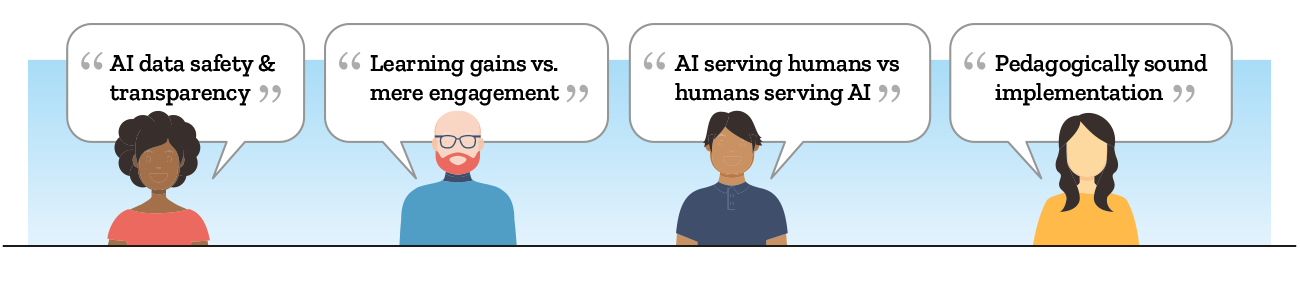
The survey responses about AI revealed a clear tension between rushing to ship AI features and thoughtfully implementing AI that serves genuine educational needs.
“Curating the use of AI to ensure it serves HUMAN needs, and not the other way around,” explained Rebecca Cuevas, founder at Learn and Get Smarter. “Making sure that human learning is at the forefront, so that AI in education makes life better for PEOPLE.”
Meanwhile, Janice Mattheis, founder at EduPlans.ai, is watching the market evolve: “I expect an even bigger emphasis on AI quality and safety in 2026. I’m already getting more questions about hallucinations, consistency, and the safeguards around output. EdTech products will need to be far more transparent about the logic, the pedagogy, and the protections built into their AI.”
Adam Black, PhD, Founder at Enabling Insights who advises Higher Ed, K–12, corporate learning, and consumer education clients that include publishers, EdTech companies, and institutions, frames the challenge with particular clarity: “AI has upended long-standing assumptions about teaching, learning, and assessment faster than most product companies can adapt. The market is moving from preventing learners from using AI, to accepting its use, to cautiously experimenting with new pedagogical and assessment models. For product leaders, this creates a dual challenge: existing products and value propositions are being structurally eroded, even if short-term revenues are only just beginning to reflect that. At the same time, the contours of new market needs are only starting to emerge, making investment decisions in next-generation products riskier and harder to justify.”
How AI in EdTech is Maturing in 2026
AI is moving from experimental to embedded in existing systems. Users now compare EdTech AI to ChatGPT, Claude, and other consumer platforms they use daily, creating new expectations for what “AI-powered” should mean.
According to 1EdTech, the question in 2026 isn’t “whether” to use AI but “how and under what conditions.” Holon IQ’s 2026 Global Education Outlook identifies “AI with accountability” as one of four major strategic themes. The emphasis is on governed deployment with focus on practical gains in workflow efficiency, instructional quality, and learner support.
The shift is fundamental: EdTech companies must now deliver AI features that genuinely enhance learning, not just match competitor offerings. Users can already access powerful AI tools for free elsewhere. EdTech AI must demonstrate domain-specific value through thoughtful design and integration that general-purpose tools can’t match.
According to Adam Black, maturity brings new complexity. The transition from AI pilots to production-grade systems that institutions can trust creates fundamental challenges for product teams. The shift from preventing AI use to accepting it to cautiously experimenting with new pedagogical models is happening faster than product development cycles. Traditional feature development assumes relatively stable user workflows and clear success metrics. AI-powered learning systems are probabilistic, adaptive, and personalized in ways that make conventional UX and analytics practices insufficient on their own.
Traditional UX optimizes screens and workflows. AI implementation requires reasoning about how systems behave over time, how they build (or erode) learner trust, and how personalization affects outcomes at scale. As Adam Black notes, success depends on teams being able to “reason about system behaviour, not just screens, design for trust and learner agency, not just usability, and instrument products so learning, behaviour, and outcomes can be observed and refined continuously.”
Getting the Balance Right Between Engagement and Outcomes
A critical distinction is emerging: engagement metrics alone no longer justify EdTech investments, but engagement remains essential for driving the practice and persistence that lead to measurable outcomes.
The most successful products will be those that prove their engaging experiences translate into the learning gains and skill development that institutions are accountable for delivering. Products that create loyalty through genuinely enjoyable experiences have already solved one of the hardest challenges in EdTech. The next challenge is proving that enjoyment doesn’t mean lack of educational rigor.
How Strategic UX Research Navigates AI Implementation
Product leaders face competing pressures: market expectations to ship AI features quickly versus user demands for thoughtful, pedagogically sound implementations. Without clear frameworks for AI decision-making, teams struggle to know when they’re genuinely enhancing learning versus adding complexity that undermines it.
Strategic UX research provides the framework for making confident AI decisions — distinguishing between technical capability and genuine educational value.
“The ease of AI prototyping is both powerful and perilous. When you can create something that feels ‘finished’ in hours instead of weeks, there’s an enormous temptation to skip conceptual validation and jump straight to building. But polish doesn’t equal value. Following the design process — validating needs first, then solutions — means being willing to walk away from impressive prototypes if they’re solving the wrong problems.”
— Trevor Minton, Chief Experience Officer, Openfield
The Openfield Strategic AI Implementation Framework, developed from extensive work with EdTech companies navigating AI integration, shows how smarter UX research guides AI implementation:
Strategic UX research starts with the learning problem, not the AI capability. The most common pitfall in EdTech AI implementations is starting with “Where can we add AI?” Research reframes this as “What user problems remain unsolved?” and validates whether AI genuinely addresses those problems better than alternatives. Technology-first approaches typically result in features that showcase AI capabilities but fail to deliver meaningful value.
UX research and design create transparency, control, and educational integrity. Through user research, teams learn what levels of transparency users need to trust AI decisions, what controls they want over AI behavior, and how to communicate AI limitations honestly. Research consistently shows that users want to understand how AI makes decisions and what data it uses. Design then translates those insights into interfaces that build trust rather than erode it.
Strategic research identifies where AI amplifies human capabilities versus where it undermines them. The most successful EdTech AI implementations don’t replace human judgment — they enhance it. UX research reveals where AI gives teachers back time, provides insights they couldn’t get otherwise, or enables personalization at scale. It also identifies where AI attempts to replace what humans do well, which typically fails.
UX research validates both efficacy AND unintended consequences. Validation research for AI features requires specialized approaches. You need to test not just whether the AI “works” technically, but whether it develops or erodes the skills students need. Research distinguishes between testing the core value proposition versus testing the technical implementation, revealing problems that pure technical testing misses.
As Adam Black points out, the validation challenge intensifies as products move from pilots to production scale. Research must address not just whether AI works in controlled conditions, but whether it remains safe, transparent, aligned with institutional policy, affordable to operate at scale, and robust enough to withstand policy swings and budget pressure. These production-grade requirements — what Black describes as separating “education companies that treat AI as a foundational capability from those that continue to treat it as a feature” — demand validation approaches borrowed from high-stakes sectors like finance and pharmaceuticals, adapted for educational contexts.
Strategic UX research enables iterative AI development with real users. The interface for many AI implementations defaults to a chatbot, but research consistently shows this isn’t always the most effective approach. Users like conversational tone but don’t want to chat. Starting small with 5-10 users, gathering insights, and scaling based on validated success reduces risk and builds confidence in AI decisions. To learn how we brought a staged approach to rapid feature development for iClicker working with 5-10 first, then 5,000 before releasing to all users, check out this case study.
The confidence gap around AI widens when teams make decisions based on competitive pressure or technical capability alone. Strategic UX research closes that gap by ensuring every AI implementation decision is grounded in evidence about genuine user needs, appropriate transparency, and actual educational impact.
“With iClicker’s AI Question Creator, we started lean with two days of UX work to remove usability barriers for five to ten alpha instructors. We focused on validating whether AI actually solved their question creation challenges, not on polished interfaces. That progressive scaling from a small alpha to a beta of 5,000 instructors to full launch proved UX accelerates AI experimentation when applied strategically, not comprehensively.”
— Jordan Aguilar, UX Designer, Openfield
→ Strategic Implication:
The most common AI pitfall starts with “Where can we add AI?” rather than “What user problems remain unsolved?” Distinguishing between technical capability and genuine educational value requires validation research that tests both efficacy and unintended consequences on student skill development. Moving from pilots to production demands teams that can reason about system behavior, design for trust and learner agency, and validate using approaches proven in high-stakes sectors.
The Reality Gap Between EdTech Vision and School Readiness

What Product Leaders Told Us About The Reality Gap in Our Survey
Chris Kelly, founder at Ashe Career, offered one of the most pointed observations: “The divide between where the schools really are in their technology journey and where the EdTech vendors are is greater than ever. Companies are pitching products that do not remotely resemble where schools are.”
When asked about the root cause, Kelly explained: “I think the big problem is that private equity wants companies to add these features for valuation without any thought of where the schools are in their journey.”
Why EdTech Products are Missing the Mark
The gap Kelly identified manifests in multiple ways. EdTech companies pitch sophisticated AI features to schools still struggling with reliable WiFi. Vendors build for best-case scenarios — the latest devices, strong technical support, digitally fluent teachers — that don’t reflect most schools’ reality. Products assume implementation capacity that doesn’t exist when IT departments are stretched thin and professional development budgets have been cut.
The pressure to add features for competitive positioning or investor expectations often overrides the question of whether schools are ready to use those features effectively. AI-assisted development is lowering barriers to creating software, making it easier than ever to build sophisticated capabilities. But ease of building doesn’t translate to ease of adoption.
How Strategic UX Research Closes the Reality Gap
Product roadmaps driven by investor expectations or competitive pressure rather than validated user needs create a dangerous disconnect. Teams lose confidence when they suspect they’re building for the wrong reality. When product leaders can’t ground decisions in authentic understanding of user context, they’re essentially making expensive bets with incomplete information.
This is where strategic UX research becomes the bridge between vendor assumptions and school reality.
“Meeting users where they are doesn’t mean limiting what’s possible — it means designing for progressive sophistication. Research shows us the actual capacity users have today, then design creates experiences that start simple while enabling growth over time. That’s how you bridge the gap between vendor vision and school reality.”
— Trevor Minton, Chief Experience Officer, Openfield
User research grounds product decisions in actual user contexts, not assumptions. Strategic UX research tests with users in their real environments, not ideal conditions. A feature that works beautifully in a well-resourced pilot school may completely fail in a typical classroom. Research captures that reality before you build, not after you’ve launched.
Strategic research reveals the full implementation context. Through contextual inquiry and stakeholder research, UX teams uncover the constraints that determine success or failure: infrastructure limitations, actual training capacity, realistic change management resources, and genuine institutional support. This research answers not just “Can we build this?” but “Can our users actually implement this successfully?”
UX design enables progressive sophistication that meets users where they are. Based on research insights about actual user capacity, design can create experiences that start simple while enabling growth over time. This might mean designing workflows that work in low-bandwidth environments, or building features that unlock progressively as users develop capability.
Strategic UX research provides the evidence that defends against misaligned feature requests. When investors, competitors, or internal stakeholders push for features, user research gives you the most powerful response: evidence of what users actually need. Data about real user struggles is your best defense against feature creep driven by external pressure rather than user needs.
The vendor-school reality gap exists because teams build for ideal scenarios they imagine rather than real contexts they’ve observed. Strategic UX research closes that gap by grounding every major product decision in authentic understanding of user context — not just what users want, but whether they can actually implement it successfully.
→ Strategic Implication:
The disconnect between vendor assumptions and school realities is fundamentally a research problem. Products succeed or fail based on how well teams understand not just what features users want, but the implementation context that determines whether features gain traction or stall.
Policy Uncertainty and Its Ripple Effects

What Product Leaders Told Us About Policy Uncertainty in Our Survey
Multiple survey respondents cited policy and political factors among their top concerns.
“Uncertainty in the market has led to a slowdown in development overall,” explained Kevin Gray, founder at Product and Process LLC who advises education companies at critical growth moments to optimize products, streamline processes, and accelerate market success. When asked what would improve his success, Gray pointed to concerns about changes in immigration policy affecting international students, education research funding, and the growing emphasis on school choice models.
Stephanie Cizdyn, CEO & President of the BLPS Group, a premier publishing services and compliance company serving the K-12 and higher education industry in the United States and abroad, also listed increasing regulatory compliance and a lack of a common goal as top challenges in 2026.
What’s Shaping the Policy Environment in 2026
The concern about policy uncertainty reflects real shifts in the education landscape. According to eSchool News, “a major pivot point will be how schools choose to allocate funding — toward emerging AI programs like ChatGPT’s education initiatives or toward hands-on materials and science equipment that ground learning in the physical world.”
Rising operational costs for schools, demographic shifts affecting enrollment, and debate over the role of federal funding in education all create an unstable planning environment. The policy questions extend beyond just funding levels to fundamental questions about the direction of American education.
How Strategic UX Helps Navigate Policy Uncertainty
When the policy landscape feels unstable, product leaders struggle to commit to long-term strategies. Uncertainty about funding sources, regulatory requirements, and institutional priorities makes it hard to plan roadmaps with confidence.
While no product strategy can eliminate policy uncertainty, strategic UX research and design can reduce its impact by keeping you close to your users and adaptable to changing conditions.
Strategic UX research informs adaptive roadmaps with decision points rather than rigid long-term plans. Instead of committing to a fixed three-year roadmap, research helps you identify key decision points where you’ll reassess based on market conditions and user feedback. Research reveals what signals would indicate it’s time to pivot, what user needs are stable versus shifting, and which features provide flexibility for future adaptation.
“Policy uncertainty means you need adaptive roadmaps with decision points rather than rigid three-year commitments. Strategic research identifies signals that indicate when to pivot, which user needs remain stable, and where to build flexibility.”
— Brian Keenan, Co-founder, Openfield
User research across market segments reveals where policy risk is concentrated. Products dependent on a single funding source or single institutional type are most vulnerable to policy shifts. Research across multiple segments — K-12 and higher ed, public and private, domestic and international — shows you where demand remains stable and where policy creates headwinds, helping you diversify strategically rather than reactively.
Ongoing user research provides early warning signals about policy impacts. Your customers will feel policy impacts before you see them in your own data. Strategic research programs that include regular customer check-ins about their planning, priorities, and budget outlook give you early warning signals about trends that haven’t reached industry reports yet. This longitudinal research approach helps you stay ahead of market shifts rather than reacting to them.
UX research focuses you on fundamentals that transcend policy cycles. Research into user needs reveals the problems that matter regardless of who’s making education policy. Efficacy, usability, and measurable learning outcomes remain critical across political shifts. Strategic research helps you distinguish between building for temporary policy opportunities versus solving genuine user problems that will remain important across changing political landscapes.
Policy uncertainty creates a confidence gap because it makes the future feel unpredictable. Strategic UX research closes that gap by keeping you connected to what actually matters to your users, providing early signals of change, and helping you build products grounded in solving fundamental problems rather than exploiting temporary policy windows.
→ Strategic Implication:
When policy feels unpredictable, adaptive roadmaps informed by continuous user research provide stability. Products grounded in solving fundamental user problems that transcend policy cycles — efficacy, usability, measurable outcomes — remain essential regardless of political shifts. The teams that navigate uncertainty best are those who build flexibility through market diversification and early-warning signals from ongoing customer research.
What Other EdTech Trends Should Product Leaders Watch in 2026?
While our survey responses revealed the immediate challenges on product leaders’ minds, several broader industry trends warrant attention as you plan for 2026.
Accessibility Compliance is Creating a Red Alert for EdTech in 2026
In less than 90 days, April 24, 2026 represents a hard deadline that will reshape the EdTech industry — and most institutions aren’t ready. The Department of Justice finalized new ADA Title II regulations in April 2024, establishing the first-ever enforceable technical standards for digital accessibility. This isn’t another “nice to have” initiative — it’s a federal mandate with significant legal and business consequences.
What Changed With the New Regulations?
For the first time, public K-12 districts and universities face explicit, mandated standards: all digital content must meet WCAG 2.1 Level AA requirements. This includes websites, mobile apps, LMS platforms, course materials, third-party EdTech tools, and videos (which now require both captions AND audio descriptions — a requirement many institutions are severely underestimating).
Key Dates in the Compliance Timeline:
- April 24, 2026: Mandatory compliance for public entities serving populations of 50,000+ (includes most K-12 districts and public universities)
- April 26, 2027: Mandatory compliance for smaller entities
The most critical change for EdTech companies: public entities are legally liable for third-party vendor compliance. Schools and universities cannot delegate this responsibility. If your EdTech product doesn’t meet WCAG 2.1 Level AA standards, institutions using your product face legal exposure.
For more info, check out this article from Inside Higher Ed.
Why This Matters More Than Previous Accessibility Guidance
Previously, accessibility was often handled through “accommodation on request.” The new regulations require “accessible by default” — everything must be compliant upfront, not retrofitted when a lawsuit arrives.
While there are no new government enforcement mechanisms, the unambiguous standard provides plaintiffs’ attorneys with clear grounds to target non-compliant entities. Industry analysts expect 5,500+ federal lawsuits in 2026, with private demand letters outnumbering filed complaints by 7-10x.
The readiness gap is significant. Nearly half of U.S. universities have only one or two staff members working on technology accessibility, and one-third of instructors remain completely unaware of the new requirements. Only 22 percent of instructors consider accessibility when designing course materials. As one higher education analyst warned, full compliance by all institutions in the next three months “just not going to happen.”
What New Accessibility Regulations in 2026 Mean for EdTech Companies
Public schools represent approximately 70% of the K-12 EdTech market. Non-compliant vendors face significant disqualification risk. Procurement processes have already begun adding strict accessibility requirements and VPAT (Voluntary Product Accessibility Template) verification to RFPs.
If Your Product Doesn’t Meet WCAG 2.1 Level AA Standards by April 2026, You Risk:
- Disqualification from procurement processes at major districts and universities
- Legal liability exposure for institutional customers
- Loss of market access to the majority of K-12 and all public higher ed
- Brand damage from accessibility lawsuits
- Competitive disadvantage as buyers prioritize compliant vendors
“Accessibility isn’t something you bolt on at the end to meet compliance — it’s a design principle that makes products better for everyone. Companies scrambling to remediate by April are learning an expensive lesson: building accessibility into your design process from the start costs a fraction of retrofitting later. When you design with inclusive principles, compliance becomes a natural outcome rather than a crisis.”
— Annie Hensley, Director of UX Design, Openfield, IAAP Certified Professional in Accessibility Core Competencies (CPACC)
Strategic Approaches for Accessibility in 2026
Document your remediation plan immediately. With less than 90 days until the April 2026 deadline, full compliance may not be achievable for complex systems. Focus on demonstrating good-faith effort: documented assessment of current state, prioritized remediation roadmap, and evidence of progress.
Go beyond automated tools. Automated accessibility checkers only identify 30-40% of compliance issues. Manual auditing, user testing with assistive technologies, and expert review are essential.
Don’t underestimate video requirements. Audio descriptions (narrated descriptions of visual content) are now required alongside captions. Many companies are focused on caption compliance while overlooking this requirement entirely.
Treat accessibility as a product differentiator, not just compliance. Companies that build accessibility into their design process from the start create better products for all users while meeting legal requirements.
Help your customers understand their liability. EdTech companies that can clearly communicate their compliance status, provide verified VPATs, and demonstrate ongoing testing processes will have competitive advantage in procurement.
Workforce Learning: The Rise of Upskilling and Reskilling
The biggest momentum in EdTech now sits outside traditional education settings. Organizations are looking for practical ways to give staff hands-on experience with AI, data, and emerging technologies without relying solely on universities or lengthy in-house programs.
Short-form learning, micro-credentials, and simulation-based training are becoming the preferred route, especially in sectors where skills gaps are widening faster than roles can be filled. Employers are rethinking how they build capability, moving away from traditional degree requirements toward competency-based approaches.
The investment data validates this shift. According to Holon IQ’s 2026 Global Education Outlook, workforce training attracted the most M&A activity in 2025, with investment concentrated in systems, infrastructure, and job-aligned upskilling. Owl Ventures projects the global education and training market will surpass $10 trillion by 2030, with corporate upskilling representing a substantial portion of that growth.

The opportunity for EdTech companies traditionally serving K-12 or higher ed is significant. The skills are often similar — data literacy, critical thinking, technical proficiency — but the delivery model and speed of implementation differ significantly.
“The biggest insight from our work spanning student skill development and corporate upskilling: learners resist training that feels separate from their real goals. Students need direct connections between skills and career aspirations. Employees view L&D as a distraction from ‘real work.’ EdTech companies expanding into workforce learning can’t just adapt their K-12 or higher ed products. They need to fundamentally rethink how learning integrates into daily workflow rather than competing with it.”
— Annie Hensley, Director of UX Design, Openfield
Career and Technical Education Gets a Technology Upgrade
As enrollment in Career and Technical Education (CTE) programs increases and the value of career and technical education gains recognition, schools are discovering that their EdTech tooling hasn’t kept pace with the sophistication needed to prepare students for modern technical careers.
“I think we will also continue to see a shift towards CTE and career readiness,” Kevin Gray predicted in our survey — a forecast supported by broader industry analysis.
CTE is no longer just shop class and typing. Programs now require simulations, industry-standard software integrations, project-based learning platforms, and portfolio systems that bridge directly to employment opportunities. The challenge is that most EdTech has been built for traditional academic subjects, leaving CTE programs underserved by technology.
Holon IQ’s outlook confirms this trend, noting that governments across regions are prioritizing vocational pathways and early-career pipelines as part of their education strategies. Vocational expansion is particularly prominent in Europe, Latin America, MENA, and South & Southeast Asia.
EdTech companies that can authentically serve CTE needs — understanding industry standards, certification requirements, and hands-on skill validation — have an opportunity to support a growing and increasingly well-funded segment of education.
“EdTech products need to do more than the bare minimum to adapt to CTE program opportunities. Success requires authentic understanding of industry standards, certification requirements, and how hands-on skill validation actually works in technical fields. They can’t just be treated like another subject area. These programs bridge directly to employment, which means the stakes and expectations are fundamentally different from traditional academics.”
— Jacob Hansen, UX Design Lead, Openfield
Interoperability and Business Model Evolution: When Integration Becomes Non-Negotiable
The Market Demand for Integration
Fragmented systems are no longer acceptable. As EdTech tools proliferate, the burden of managing multiple disconnected platforms is overwhelming schools and districts. In 2026, interoperability is shifting from a best practice to a buying requirement.
“For years, interoperability has been discussed as a best practice; something institutions should aspire to if time, budget, and technical capacity allowed,” notes 1EdTech. “In 2026, that mindset is shifting.”
Policy-level mandates are driving this change. France’s Interoperability Framework for Digital Services for Education decree represents the kind of regulatory pressure that makes interoperability non-negotiable. But policy isn’t the only driver. Institutional procurement requirements increasingly prioritize integration capabilities, and schools expect EdTech tools to work within existing ecosystems rather than demanding schools adapt to them.
Holon IQ identifies infrastructure as one of four major strategic themes for 2026, noting that “progress remains incremental, but momentum is building toward interoperable platforms, shared data standards, and connected ecosystems.”
How Product Leaders are Responding
This market shift is forcing fundamental business model questions for EdTech companies. The demand for interoperability isn’t just about technical integration — it’s reshaping how products are architected, sold, and delivered.
“My biggest challenge is evolving from a product that teachers use directly to an API that powers many different EdTech products behind the scenes,” explained Janice Mattheis, founder at EduPlans.ai. “That shift requires strategic thinking. The demand for AI-supported lesson design is high, but making it scalable, predictable, and trustworthy across partners is the real challenge.”
Mattheis outlined what success looks like: “Success this coming year is tied to how well we complete the transition from a single product to a fully uncoupled system. Right now, our UI and backend API are tightly connected, which limits how flexible we can be with partners. Once we fully separate the two, the backend becomes a true instructional intelligence API that any EdTech platform can plug into, while allowing the UI to evolve independently.”
Her challenge reflects a broader pattern: EdTech consolidation is accelerating as institutions demand unified platforms rather than managing multiple disconnected tools. Platforms are moving from supplemental tools to backbone infrastructure. The question increasingly isn’t whether to build, buy, or partner for capabilities like AI, but which combination creates the most value.
According to 1EdTech’s report on 2026 trends, “success in 2026 won’t come from adopting more tools, but from building ecosystems grounded in interoperability, governance, and shared responsibility.”
The Strategic Stakes of Business Model Pivots
Strategic pivots in business model — direct-to-user versus B2B API, standalone versus embedded, build versus partner — carry enormous risk. The partnership versus platform question carries enormous strategic weight. Building everything in-house offers control but requires significant resources and may duplicate work others have done better. Relying on partners offers speed and specialization but introduces dependencies and integration complexity. Getting this decision wrong can cost years of development time and millions in resources.
The confidence gap shows up as uncertainty about whether enough potential partners would actually adopt your API, questions about whether your core IP can sustain a platform business model, concerns about whether you can support enterprise partnerships with current team structure, and doubt about timing.
How Strategic UX Research Validates Integration and Business Model Decisions
When interoperability becomes a market requirement and business models must evolve to meet it, strategic UX research provides the framework for making these high-stakes decisions with confidence.
“The interoperability challenge isn’t just technical — it’s also about user experience. Students, instructors, and administrators juggle extensive toolkits that show fragmented views of the same information, making it nearly impossible to have a single source of truth. People don’t need another product added to that ecosystem. They need the right information at the right time, in context, so they can make decisions quickly and confidently. That’s what strategic integration actually delivers.”
— Kyle Bentle, UX Design Lead, Openfield
Strategic research validates market appetite before major architectural changes. Small-scale tests with potential partners can answer fundamental questions before you commit to rebuilding your entire product. What would partners actually pay for? What integration points matter most? What level of customization do they need? UX research with potential partners answers these questions with evidence, not assumptions.
UX research treats partner needs as rigorously as end-user needs. If you’re pivoting to a B2B API model or building for interoperability, your buyer has changed. Strategic research uncovers their decision-making process, technical requirements, implementation capacity, and success metrics. Partner research often gets shortchanged because teams assume business buyers are more rational or their needs are more obvious. Neither is true.
Strategic UX enables testing new business models with pilot customers before full commitment. Research identifies partners willing to be early adopters, validates your approach through their implementation, and reveals gaps in your strategy that you can’t see from inside your own organization. This de-risks major pivots before you’ve committed engineering resources.
UX design builds flexibility into product architecture to enable future pivots. Even if you’re not ready to fully separate your UI from your backend today, strategic design decisions can preserve that option for later. Research reveals which architectural decisions provide strategic flexibility versus which create lock-in. The cost of refactoring later is almost always higher than building with modularity in mind from the start.
Success in 2026 won’t come from adding more features — it will come from making those features work seamlessly within the complex ecosystem of tools schools already use. And the business models that thrive will be those built on validated understanding of how institutions want to integrate EdTech into their infrastructure.
How Are Skills-Based Credentials Changing Education?
Shifting employer expectations and the growing influence of AI are accelerating the move toward a skills-driven ecosystem. Traditional degrees are being supplemented (and in some cases replaced) by verifiable digital credentials that demonstrate specific competencies.
“One of the most exciting developments we’re watching in 2026 is the long-anticipated rise of digital credentials and digital competencies,” reports 1EdTech. “Institutions are increasingly using AI to support personalized learning pathways that help learners identify skill gaps, develop competencies, and earn verified digital credentials aligned with workforce needs.”
Holon IQ’s 2026 outlook confirms this as a major strategic theme, noting that “skills transparency and alignment is affecting policy and pedagogical decisions across the teaching and learning continuum.” As frameworks for skills mature, demand will shift toward initiatives that make outcomes and skills visible and pathways navigable.
The market for digital credentials is experiencing exponential growth. According to EdTech Innovation Hub research, the educational platform Accredible issued 36 million digital certificates in 2024 — 45% more than the previous year.
This convergence connects directly to both workforce upskilling/reskilling and Career and Technical Education. Both benefit from granular, verifiable ways to demonstrate competency without requiring full degree programs.
“Skills-based credentials create a new challenge: showing students their competency landscape without overwhelming them. Students don’t need to see every possible skill they could develop — they need a clear roadmap showing where they are, where they’re headed, and what to prioritize next. Effective solutions reduce cognitive load by helping students focus on the most impactful skills for their goals.”
— Tanner Sotkiewicz, UX Design Lead, Openfield
Conclusion: From Uncertainty to Strategic Action
The challenges facing EdTech product leaders in 2026 are real. Budget pressures intensify. Schools struggle to keep pace with vendor assumptions. AI creates both opportunity and confusion. Policy uncertainty makes long-term planning difficult.
And yet, genuine opportunities exist for product leaders who approach these challenges strategically.
Here’s what we’ve learned from nearly two decades working exclusively in EdTech: The confidence gap — the distance between what product leaders need to know with certainty and what they actually know when making critical decisions — doesn’t close by accident. The forces creating it have only intensified in 2026. But teams that close this gap share a common approach: they’ve built frameworks for making confident decisions when the landscape feels uncertain.
What Strategic Confidence Looks Like in Practice
It means starting with validation, not assumptions. Before committing engineering resources to major features, successful teams invest in understanding whether they’re solving problems users actually have. A small research investment that reveals you’re solving the wrong problem is infinitely more valuable than an efficient build of the wrong solution.
It means testing in real contexts, not ideal scenarios. The vendor-school reality gap exists because teams build for best-case scenarios rather than typical conditions. Understanding implementation context — the actual infrastructure, the real training capacity, the genuine change management resources available — matters as much as understanding feature requirements.
It means combining quantitative and qualitative insight. Usage data tells you what users do. Qualitative research tells you why they do it and what they’re trying to accomplish. Teams that rely on analytics alone make decisions based on incomplete information.
It means including stakeholders early in the process. The best product design won’t overcome misalignment with institutional priorities, procurement requirements, or implementation realities. Early stakeholder involvement prevents costly rebuilds.
It means building evidence loops into development. Research isn’t a phase — it’s an ongoing practice that informs every major decision. Teams that treat validation as continuous rather than episodic catch problems early, adapt faster, and build confidence through accumulated evidence.
“Strategic confidence comes from knowing which decisions carry the highest risk, investing in validation before commitment, and building evidence loops that catch misalignment early. Teams that treat research as continuous practice adapt faster and make better decisions, even when the landscape keeps shifting.”
— Sarah Freitag, Director of UX Research, Openfield
The Truth About UX and EdTech Product Success
Great UX research and design alone won’t make your product succeed. Learning science matters. Market timing matters. Business model matters. Go-to-market strategy matters. Engineering quality matters. Pricing matters.
We’ve seen strong products with solid business models fail because users couldn’t figure out how to get value from them. We’ve watched well-funded companies burn through resources building sophisticated features nobody wanted. We’ve witnessed promising startups lose deals because they couldn’t demonstrate their product would work in real school contexts.
Strategic UX research and design doesn’t guarantee success. What it does is ensure you’re not derailed by avoidable problems. It closes the gap between what you need to know and what you know with certainty. It helps you solve the right problems, design solutions that genuinely work, and enable engineering to build efficiently without costly reworks.
The Questions That Matter for EdTech Product Leaders in 2026
As you plan your product strategy, here are the questions that separate confident decisions from expensive guesses:
Are you solving problems institutions can’t afford to leave unsolved? In a market where everything is judged by accountability metrics, compliance requirements, and operational necessities, “nice to have” features face elimination. Products that address mandates, reduce critical pain, or deliver measurable outcomes position themselves in protected budget categories.
Do you understand where schools actually are, not where you assume they should be? The vendor-school reality gap widens when product decisions are driven by competitive pressure or investor expectations rather than validated user needs. Products built for ideal scenarios fail in typical contexts.
Can you prove your product delivers on institutional priorities? Engagement metrics alone no longer justify investments. Buyers demand evidence that your product drives the outcomes they’re accountable for delivering.
Are your AI implementations genuinely enhancing learning or just checking boxes? Users can access powerful AI tools for free elsewhere. EdTech AI must demonstrate domain-specific value through thoughtful design and integration that general-purpose tools can’t match.
“The risk isn’t just building something people don’t want — it’s building something that solves a problem that isn’t urgent, or that’s already solved well enough by free alternatives. Strategic research reduces that uncertainty by testing assumptions in sequence: Is the problem real? Is your approach differentiated? Will people actually switch? You won’t eliminate risk, but you’ll know where it lives before you commit resources.”
— Alex Turvy, PhD, UX Researcher, Openfield
Have you evolved beyond treating AI as a feature to building it as a foundational capability? The transition from AI pilots to production-grade systems requires teams to reason about system behavior, design for trust and learner agency, and instrument products for continuous learning. Traditional UX and analytics practices offer limited value here — success depends on validation approaches proven in high-stakes sectors, adapted for educational contexts.
Moving Forward in the Face of Uncertainty
The market has reset around a fundamental truth: institutions can’t afford wrong product decisions. The uncertainty of 2026 isn’t going away, but teams that know how to navigate it with greater strategic confidence will find genuine opportunities where others see only obstacles.
Those opportunities belong to teams who validate before they build, who test in real contexts, who combine data with understanding, who include stakeholders early, and who treat research as an ongoing practice rather than a one-time phase.
The teams that will thrive in 2026 aren’t necessarily those with the biggest budgets or the most advanced technology. They’re the ones who have frameworks for closing the confidence gap — for making decisions grounded in evidence rather than assumptions, for building products that solve problems users actually have, and for proving value in ways that resonate with increasingly skeptical buyers.
That’s what strategic confidence looks like. And that’s what 2026 demands.
TL;DR: Key Takeaways for EdTech Product Leaders in 2026
Budget pressures are intensifying, but it’s about selective allocation. Institutions are simultaneously cutting and investing. Programs demonstrating measurable impact on accountability metrics get protected; “nice to have” tools face elimination. Global EdTech VC reached $2.4B in 2025, concentrated in workforce-aligned and AI-enabled models.
The vendor-school reality gap is widening. Products built for sophisticated technical environments often don’t match where schools actually are. Success requires understanding implementation context as thoroughly as user needs.
AI is at a crossroads. Users demand AI that serves genuine learning needs with accountability and transparency. Holon IQ identifies “AI with accountability” as a top strategic theme — governed deployment focused on practical gains, not experimental adoption.
Production-grade AI requires new capabilities. Moving from pilots to scalable AI systems demands teams that can reason about system behavior (not just screens), design for trust and agency (not just usability), and validate using approaches proven in high-stakes sectors like finance and pharmaceuticals.
Engagement must connect to outcomes. Engagement metrics alone no longer justify investments, but engagement remains essential for driving persistence and outcomes. Successful products prove their engaging experiences translate into measurable results.
Policy uncertainty isn’t going away. Adaptive roadmaps, market segment diversification, and focus on fundamentals provide resilience.
Workforce learning is booming. Holon IQ reports workforce training attracted the most M&A activity. The education and training market is projected to exceed $10 trillion by 2030.
CTE needs better EdTech. Career and technical education programs require specialized tools, creating opportunity for companies that understand this space authentically.
Interoperability is becoming mandatory. Schools expect tools to work within existing ecosystems. Integration capability is increasingly a buying requirement.
Skills-based credentials are accelerating. Digital badges and micro-credentials validating specific competencies are growing exponentially — Accredible issued 36 million digital certificates in 2024, 45% more than the previous year.
The confidence gap requires deliberate strategy. Success comes from knowing when and how to validate strategically, understanding which problems institutions can’t afford to leave unsolved, and having evidence that proves your product delivers on institutional priorities.
What Challenges are Shaping Your 2026 Planning?
This outlook reflects what we heard from EdTech product leaders about their biggest challenges and the trends they’re preparing for, research and analysis from leading industry sources, and insights learned from our 20 years of EdTech UX research and design.
What trends are we missing? What challenges are defining your planning for 2026? We’d love to hear your perspective.
Let’s Talk About How You Can Navigate Uncertainty With Confidence in 2026
Schedule a 30-minute discovery call to learn how you can close the confidence gap this year with elevated UX research and design that’s tailored to the unique complexities of EdTech.
About Openfield
Founded in 2006, Openfield is a UX research and design partner focused exclusively on educational technology. For nearly two decades, we’ve helped EdTech companies navigate exactly the kind of complexity and uncertainty that defines 2026.
By working in tandem with your business, learning science, and engineering teams, we help close the confidence gap. Whether you’re proving ROI to skeptical buyers, bridging the vendor-school reality gap, making AI implementation decisions, or navigating policy uncertainty — the fundamental challenge is making confident decisions when stakes are high and the landscape feels uncertain.
With more than 40,000 hours of EdTech user research and over 130,000 hours of EdTech UX experience serving more than two million users, we’ve learned this: it’s not about screens – it’s about making the right product decisions backed by data and pattern recognition that can only be learned by focusing solely on educational applications.
We help EdTech teams ensure they’re solving the right problems, designing solutions that work in real school contexts, and enabling engineering to build efficiently without costly reworks. That’s how strategic UX closes the gap between uncertainty and confident action.